
Keeping it Human
Be an ‘Opt Out’ VIP

I’ve touched on the subject of standing our ground in the face of technology before; each little stand we take serves, not only to forestall the onslaught of dehumanizing digitization and automation, but as an example for others. Almost no one is happy (except the wannabe technocrats) about technology creeping into every aspect of our lives; but who is willing to step out of line to counter this? I’ve written at length about phone technology in previous posts (and must return to this), but this time, I’d like to talk about the full body scanners we’re now seeing in airports around the world.
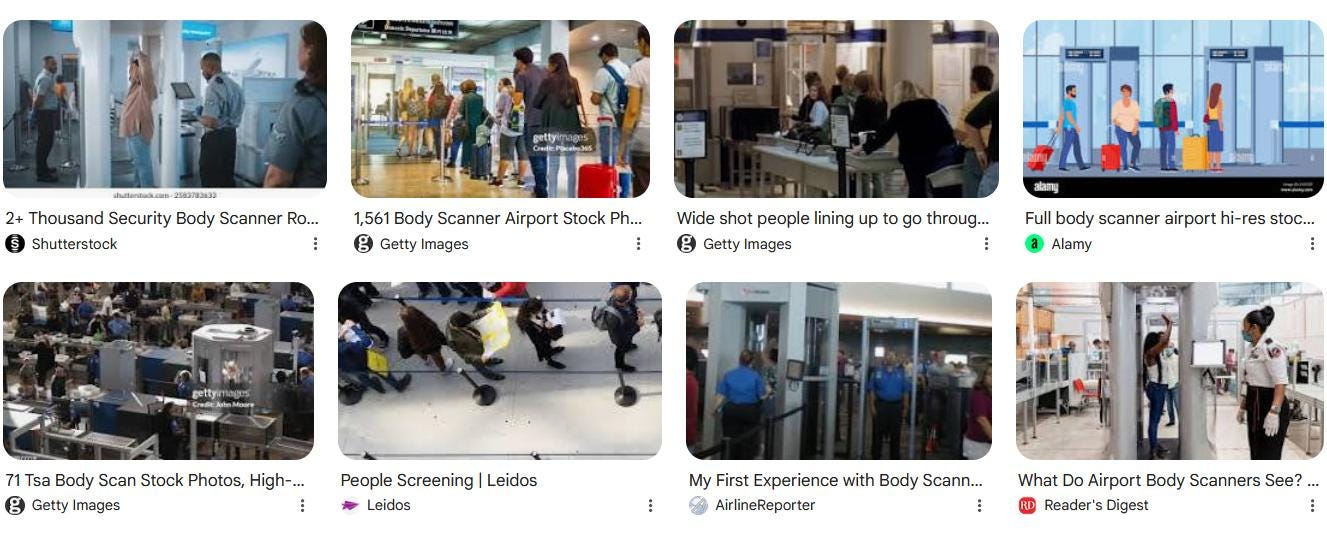
Before I tell a couple of heart-warming stories — moral tales actually; because that karma comes back to us, good or bad — let’s take a quick look at what all the fuss is about. The fuss, such as it is, currently seems to be from just a handful of ‘cranks’ like me, who just refuse to go along. I should say, I do know a handful of others, who regularly refuse to go through the body scanners, and for all of you (who would like to share your experiences in writing), here are a few sources for official images (since we’re not allowed to take pictures in the security check zone):
The primary issue, of course, is the health concerns of ‘millimetre wave’ and ‘ultra-low-dose backscatter X-ray’ technology (no matter what anyone tells you, this is not ‘sonar’):
‘[T]he FCC standard was based on the thermal effect of electromagnetic radiation (if the device does not heat the body, it does not harm the body). The biological effects of RF radiation over a long period of time on the human body at different frequency ranges have never been studied.’
The dangers of increasingly dense ‘EMF fog’ are clearly a concern, and there is much literature on this; but here we must focus on the short-term exposure, and ways to halt a dangerous trend, longer-term. There’s a lot of ‘official’ material on EMF safety of course, and on the subject of full body scanners too; mostly by manufactures and (possibly?) captured public ‘health’ agencies. I don’t profess to be an expert; I just read a lot, and a lot of stuff just doesn’t add up. . . but you can tell me (your comments here are always appreciated).
The second page to pop up when I started looking into this subject, before my first flight to the U.S. in many years, was ‘National Academies of Sciences, Engineering, and Medicine’ 2017: ‘Airport Passenger Screening Using Millimeter Wave Machines: Compliance with Guidelines.’
‘The technical difficulty of implementing the concept is a consequence of the three-dimensional nature of the subject. The solution to this technical problem, as implemented in the L3 ProVision series of scanners, is to have the subject enter a “portal,” a cylinder in which the subject stands erect, with arms raised. A linear array of antennae pairs, arranged vertically as part of a “mast,” transmits (the transmit antenna of the pair) a set of millimeter wave signals, which reflect off the subject and are received by the linear array (all the receiving antennae of each pair, approximately 200 in total for each of the two arrays).’
Here, of course, we’re talking about ‘millimeter wave’ technology, and not the ‘ultra-low-dose backscatter X-ray technology’ (ionizing radiation that is) . . . Needless to say, we only have their word on this . . . that this is ‘ultra-low-dose’ (ionizing and non-ionizing radiation). In the U.S. at least (though not here in Canada, apparently) the authorities will inform passengers. ‘Informed consent’ is important (I needn’t tell anyone here), and on my return trip from the U.S., Sunday November 8th, it was clearly stated that the full-body scanners ahead employed ‘millimeter wave technology’.
So the moment I threw my carry-on luggage, shoes, laptop and miscellaneous odds and ends, in the trays provided, I informed the attendant at the X-ray machine that I was opting out of the scanner (because of the notice they’d posted) and requesting a pat down instead. She immediately called this in, and asked me to step out of the line.
I’ll continue with this story below, but first, let me share a few more details pertaining to this technology. Of course, I’d encourage anyone who cares about their health – encroaching surveillance state and creeping authoritarianism – to do a little research of their own, but here are a few things that jumped out at me. I don’t profess to be an expert (though almost no one believes ‘experts’ anymore in any case), but this isn’t just about body scanners. EMF pollution is a serious problem, and we should all know more (than the health authorities are willing to share with us). Everything from these folks, of course, is ‘Safe and Effective;’ especially those who manufacture the equipment (and products), and profit handsomely from mandates requiring their use. ‘Stakeholder Capitalism’ is what they call this new business model.
Wikipedia, however, includes some critical opinions on this subject (which is saying something); such as the Italian Government’s decision to abandon airport body scanners. . . because they are, in fact, “slow and ineffective” (as cited there).
Captured ‘health’ authorities don’t care about this though, because their job is to pacify an ‘uninformed,’ compliant and unquestioning population, and assure them that all this new technology is convenient . . . and totally safe.
Further to this:
So we should do our home work, and see exactly what they say. Here is the CATSA link, reference above; and ‘Safety Code 6.’ There has been criticism, as you saw above, that the only ‘metric’ recorded is how much EMF radiation ‘heats’ the flesh — think microwaves here, and if you look on the back of the microwave in your kitchen, you’ll see it operates a 2,450 megahertz (MHz), or 2.45 gigahertz (GHz) — which is the same as the cool and convenient Bluetooth earbuds that people insert actually into their heads — (2.4 GHz ISM) radio band. Some people apparently don’t mind the ‘heating’ of their brains, and I’m sure there’s no connection between this and a recent spike in brain cancers. Moving on though (because you can’t tell anybody anything):
Health Canada informs us:

‘Continuous’ but not long-term. Continuously looking at the same metric (how much a certain amount of body tissue is heated by microwaves and millimetre waves that is) is not a proper study; when we also take into consideration, for instance, the genetic damage caused by long-term EMF exposure. Needless to say, the word ‘continuous’ is ‘regulatory capture’ double-speak; which is provided now everywhere, by bought and paid for Government agencies.
The health considerations of (ever increasing) EMF pollution are without doubt the main concern, but there are others, of course, related to this technology specifically. Again, as documented on Wikipedia:
‘Full-body scanning allows screeners to see the surface of the skin under clothing.[43] Prosthetics including breast prostheses and prosthetic testicles may require a potentially embarrassing physical inspection once detected. The scanners can also detect other medical equipment normally hidden, such as colostomy bags and catheters.[44] The transgender community also has privacy concerns[45] that body scanners could lead to their harassment.’
Maybe you don’t care about strangers checking out your ‘tackle’ – even the pat down avoids those regions – but the Creative Commons image shown here is completely misleading:
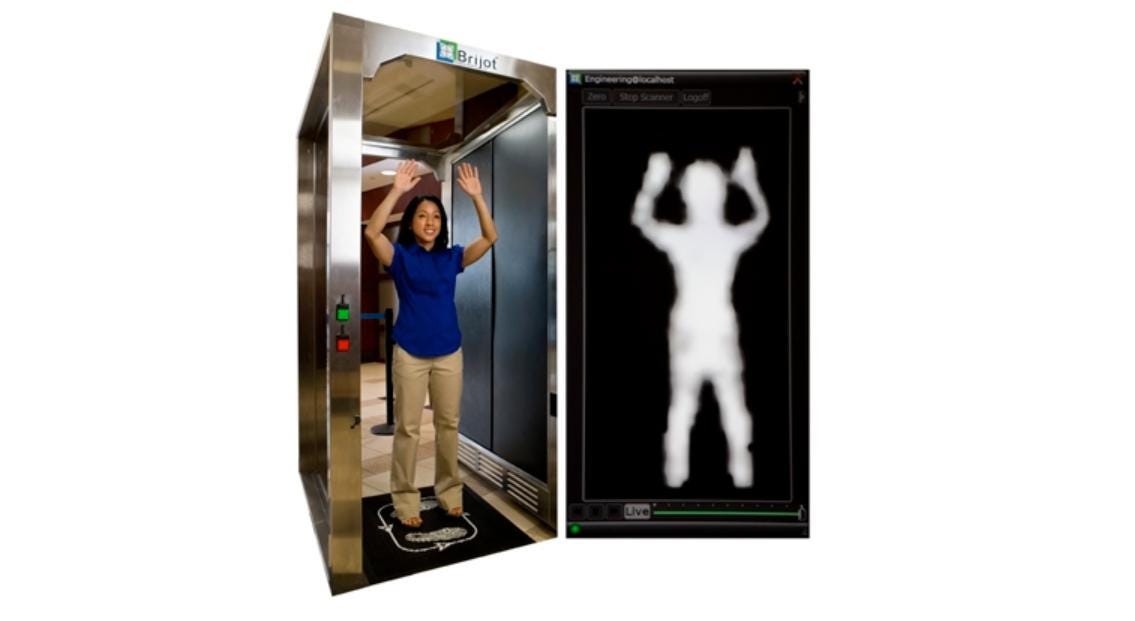
The following, is closer to reality:
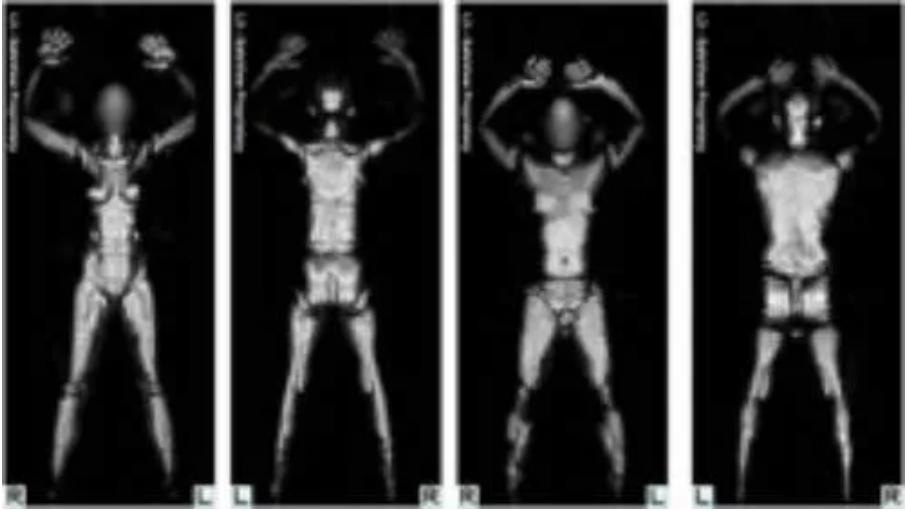
Above are real images, from https://www.livescience.com/5387-airport-body-scans-reveal.html And you can compare these to the fake (‘doctored’) government images, above at: https://www.catsa-acsta.gc.ca/en/full-body-scanner (notice the blurred faces).
Personally, I don’t care, but for a lot of folk, the revealing images above will be disconcerting. Some people see being patted down as a humiliation ritual, but I would suggest it is far more humiliating to be herded like cattle into a glass chamber (“hands above your head”) and systematically irradiated (and who really knows what level of radiation these machines emit – or can be randomly caused to emit?). Once at the mercy of the technocrats, absolutely anything is possible; and you have no idea what you are really being subjected to.
But this is enough technical stuff, let me return (should you wish to take this journey with me) to my Tale of Two Cities; Toronto, and one south of the border, in the Home of the Brave and the Land of the Free (er).
A Moral Tale (with a happy ending)
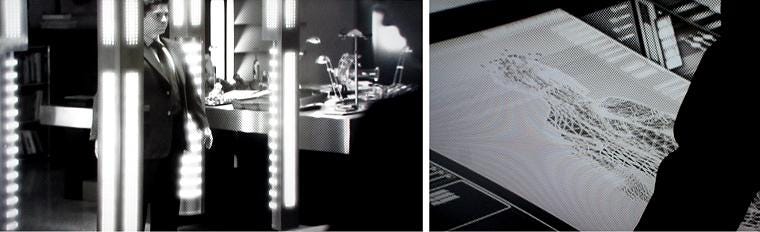
My first encounter with these full body scanners was at Toronto’s Pearson Airport. Coincidentally, I had just watched an old series of the Battlestar Galactica program; the prequel, Caprica (a story in itself that I’ll save for a future piece on the Metaverse ‘predictive programming’ PsyOp). One of the characters in this science ‘fiction’ tale submits to a full body scan in order to create an ‘avatar’ for his consciousness to inhabit once migrated into the proto-Metaverse. . . and there was no way I wanted to be subjected to this.
“But it’s totally safe,” the security guard advised me when I informed him I would opt for a pat down. “It’s just sonar.” He added. I actually didn’t know anything about this technology at the time, but I knew this was total BS. He maybe thought he’d understood what he was told about the equipment, and misspoke, so maybe this wasn’t a bold face lie; but I insisted, I was not going through the scanner.
I couple of people were summoned from behind the scenes and I was asked whether I wanted to be processed in a private room, or right here. “Right here,” I insisted. Again, giving these folk the benefit of the doubt, perhaps they thought the experience would be humiliating. I didn’t feel this way; rather, it seemed like a way to show others that there was an alternative. It would seem more alarming for people observing this, I thought, if I were taken into a back room for ‘processing’ and then they never saw me again (having moved quickly and ‘conveniently’ on, themselves).
Two staff members undertook the patting down, as it happens; a young man, and a middle aged woman (who oversaw the procedure). Perhaps the younger staff member was in training. “I’m going to have to touch you,” the young fellow said. “Not a problem,” I replied. And he proceeded, somewhat nervously it appeared. It’s a pretty simple routine, as the TSA video on the ‘Full_body_scanner’ Wikipedia page above illustrates, so I’ll not outlining the process step by step here.
“Please turn around and face me,” he then requested, “I have to do the front now”. . . Sorry.” He added, in that most disarming (and sometimes annoying) Canadian manner. At which, I couldn’t help responding: “Not to worry, I prefer the personal touch.” The lady observing actually laughed, and his demeanor changed entirely too. At one point, I even thought he might be enjoying this a little too much, but the point was, the whole experience had been changed, with a conversation and a little real human interaction.
“With all this technology,” I offered, “I just wanted to make sure you guys still have your jobs next year.” This was something that resonated; and the prospect of redundancy was not nearly so immediate then as it is today, with the full rollout of AI.
Fast forward to this past Saturday (November 8th), and a return flight from Florida; where I was surprised to encounter this equipment again. On the way down, going through U.S. security and customs at the airport in Toronto, I was happy to see there were actually none of these scanners; so I didn’t expect to see one on the return trip.
Once again, I informed the girl sorting X-ray machine trays that I would be opting for a pat down. It seems more positive this way; opting for something, rather than refusing something. Without a moment’s hesitation, she pulled out her radio and called for an assistant, and I was asked to wait off to the side. Another attendant took a minute to let me know they were short staffed that day (I now understand there was a strike going on and today was one of those ‘work to rule’ situation). In the end (and I’m guessing here) I probably had to wait twenty minutes or so longer.
As it happens, this gave me time to chat with other passengers in the line, as they filed past. I made a point of engaging anyone who actually seemed aware of my presence. Most just marched by, eyes forward, fixated on the apparatus and procedure ahead; but a few of those souls looked questioningly at me, and I said to them (pointing at the ‘millimetre wave technology’ sign): “I’ve read too many studies and I’m worried about the damage it might cause to my eyes.” Some nodded, or acknowledge in some fashion, but none questioned me, or seemed even remotely curious to know more. Maybe they would sit in the departure lounge later, and search for information themselves (I have no idea); but sadly, no one opted to join me. One by one, they stepped forward to be processed.
Occasionally, a passing staff member would question me why I was waiting there, and they nodded understandingly when I told them. They probably realized I might be there for a while. The last stragglers at the end of the line were throwing their belonging onto the X-ray machine rollers when a large African American guy opened the security gate and wave me inside.
He was BIG, like a night club bouncer, but I could feel he had a heart. My belongings had been removed from the rollers at the other side, and placed on a table. I’d been keeping an eye on them the whole time. He ran through the explanation of what he was about to do, as in the video above; I assured him I was fine with this, and that I didn’t need to go to a private room in the back. The process took no more than a couple of minutes, but it was enough time to explain to him also that, “as an artist, I’m particularly concerned about my eyes,” and again, that “I’d also like all of you here to still have a job next year.”
He too, in the present labour dispute situation especially, seemed particularly moved by my concern (from a complete stranger yet) for his well being and livelihood. “Those are your things?” He asked, pointing to my coat and lap top. He’d pulled out a swab, to screen for drug residue and whatever else it is they look for, but then he put it down again. “You’re good, he said. You can go.”
I was surprised, but thanked him, and wished him a good day; then quickly grabbed my things and headed off to find my gate, and a coffee shop. Not a minute after I picked up my coffee, I heard my name announced: “Would passenger David Ward return to security.” Hmm, and thought; but I had to go back there of course. The Starbucks was actually at the furthest point in the departure hall from security, so it took me a while to return. When I entered security again, the same fellow who had patted me down came out from behind the X-ray machine conveyors, and gestured toward the open door of a room at the back of the security area. His boss has called him out, I thought, for not doing a thorough check.
I followed him of course; but he stopped at a table beside the door, picked something up, and then walked back towards me.
“Is this yours,” he asked, holding out a memory stick.
It was (and there was some rather important information on it too). The jumble of items I’d deposited into the tray with my coat – wallet, boarding pass, passport, phone . . . and a memory stick – had all been thrown in loose, one item at a time as I emptied my pockets. When I’d scooped everything up at the other side, clearly, I’d missed this one item. It had no name on it of course, but I was the only person this security guard remembered from the last hour of work, and something about our encounter was important enough that, on a hunch, my name was located, and the call put out. Another guard, sitting behind the desk at the door, caught my eye as I left security again: “Don’t be in such a rush next time,” she said, with a smile.
So the moral of the story: Yeah, what’s the rush. . . and, of course, keep it human. Refuse all technology that promises convenience – safety and efficiency – while stealing the livelihoods of our fellow everyday working people. The anti-human technocrats get richer by gutting and dehumanizing our world; but we can stop them, by refusing to go along, and by seeking out real human interaction wherever possible. I hope all of you (and if not you, the readers of Substack, who?) will take a stand, to keep it human.
A routine security humiliation (and irradiation), was instead, for me (as I took a stand for all of us) a wonderfully human experience. My extended community grew a little more, and I made new friends. I may be in Florida again in a couple of months; perhaps our paths will cross once more, and maybe next time, I won’t be the only one ‘stepping out of line.’
Thank you all for your continuing interest and support.
David
Thanks for sharing your experience David. Opting out is not just symbolic; it slows lines to a grind, costs the airlines money, and forces human staffing. That’s pretty awesome pushback! Every single refusal is a vote for human jobs and dignity. AI is stealing jobs from humans who need them. Standing in line for a human pat-down is a quiet act of unity. Keep up the good work and keep us motivated to push back.
Thank you for sharing, David. I read with interest and will pass this along for others to consider.